

At five engineers, you don't need an org chart. Everyone talks to everyone, you know what everyone is working on, and decisions get made in Slack threads. That works, right up until it doesn't.
Somewhere between 8 and 15 engineers, the flat structure stops working. Not because anyone did anything wrong, just because coordination cost grows faster than headcount. The founder who used to review every PR is now a bottleneck. The engineer who used to onboard every new hire is now buried in it full-time. Nobody decided to make this messy, it's just what happens when a team outgrows its structure.
The shift: one team becomes an organization of teams
The fix isn't hiring more managers for the sake of it. It's recognizing that a single flat team has a ceiling, usually somewhere around 8-10 people, past which it needs to split into smaller teams with clear ownership.
Here's the shape that structure usually takes:
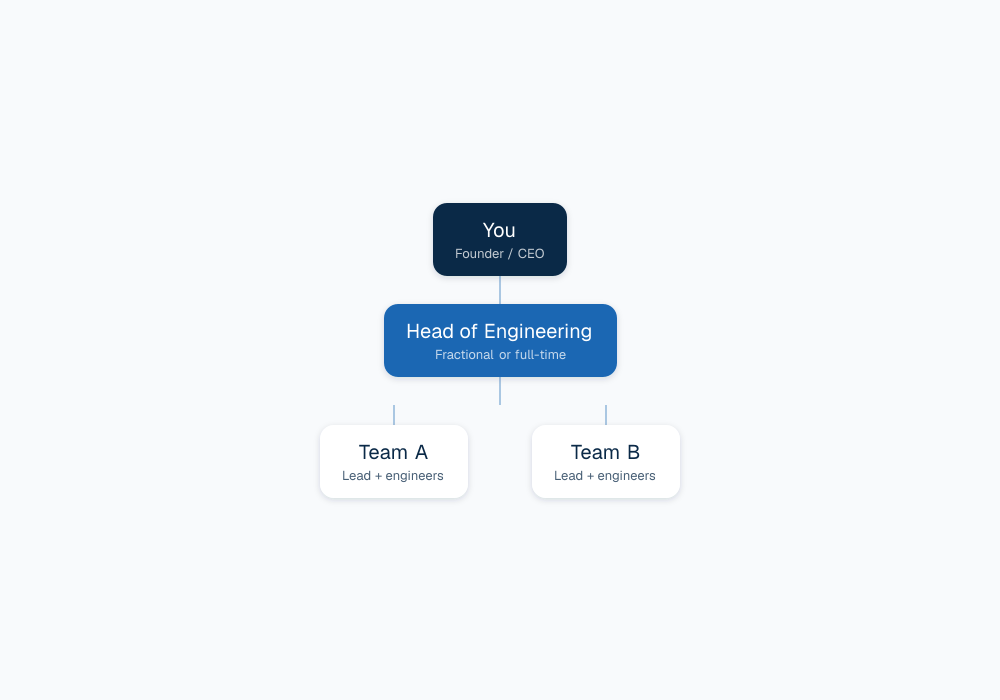
A few things worth calling out about this model:
- The founder moves up, not out. You're still involved, but you're no longer the one every technical decision routes through.
- One layer of leadership, not three. At this stage you need a Head of Engineering, not a VP, two directors, and four managers. Over-hiring management layers early creates its own coordination cost.
- Teams are small enough to actually own something. Three to six people per team, each with a clear area, is what keeps ownership real instead of theoretical.
What actually goes into "structure"
An org chart is the easy part. The parts that make it work are less visual:
- Reporting lines - who someone's manager actually is, not just who they sit near.
- Ownership boundaries - which team owns which part of the product, clearly enough that "who do I ask about X" has one answer.
- A hiring plan - whether the next hire goes into an existing team or starts a new one.
- A path for leads - the engineers who'll grow into the team-lead roles this structure needs, identified before you need them, not after.
Try it yourself
We built a free tool for exactly this: add people, set who reports to
whom, and export the result as a PNG or as a standard Graphviz .dot
file you can keep editing elsewhere.
Try the free org chart maker →
If you're past the point where a whiteboard sketch is enough and want help actually building this out, that's exactly what an engineering scale consultation is for.